

Yu Sleep Review by Natasha Morgan
The Quick Verdict (Read This First)
Yu Sleep is a liquid sleep supplement built around a low 0.9 mg dose of melatonin and a 637 mg blend of tart cherry, magnesium glycinate, L-theanine, GABA, and four other ingredients. It is designed for one specific problem: waking up at 2, 3, or 4 in the morning and not being able to get back down.
I tested it for 60 days. I paid for my own bottles. I kept a sleep log. My 3 AM wake-ups went from a nightly 90-minute ordeal to a 20-minute interruption, and some nights they did not happen at all. My afternoons stopped collapsing. My mornings got easier. That is the headline.
The honest limitation is that seven of the ten ingredients sit inside a proprietary blend with no individual doses listed. At about $2.30 a night on the smallest package, you are paying premium prices for partial transparency. But the 60-day refund window means you can test it against your own sleep log with almost no financial risk.
My rating: 4.2 out of 5. Best product I have tried for the second half of the night. Not the cheapest. Not the most transparent. The one that actually moved the needle for me.
A quick note before you scroll: Yu Sleep runs its discount as a batch price on the official site, and the site states that inventory is limited. The current $49-per-bottle price on the 6-bottle package is not a standing price. If you are going to test it inside the 60-day window anyway, today is a better day than next month.
👉 Check current batch pricing and package options on the official Yu Sleep website here.
Yu Sleep Review at a Glance
| Product | Yu Sleep |
|---|---|
| Category | Liquid sleep-support dietary supplement |
| Format | Sublingual drops, 2 droppers (2 mL) per serving |
| Key Disclosed Ingredients | Melatonin 0.9 mg, Vitamin B2 0.5 mg, Vitamin B6 0.5 mg |
| Proprietary Blend | 637 mg: Tart Cherry, Magnesium Glycinate, Apigenin, Lemon Balm, 5-HTP, L-Theanine, GABA |
| Best For | Sleep maintenance (3 AM wake-ups), not sleep onset |
| Servings Per Bottle | About 30 |
| Price Range | $49 to $69 per bottle (two-bottle minimum order) |
| Money-Back Guarantee | 60 days, processed through ClickBank |
| Where to Buy | Official website only. |
| Made In | USA, GMP-certified facility |
| My Rating | 4.2 / 5 |

Why You Should Trust This Yu Sleep Review
My name is Natasha Morgan. I am a health researcher and a wife, and I have spent the better part of a decade reading supplement labels for a living. I am the friend people text before they drop $80 on a fat burner or a green powder that tastes like lawn clippings.
I am also a genuinely bad sleeper. Not the “I cannot fall asleep” kind. The “I am out cold by 10:15, then my eyes snap open at 3:07 AM and my brain starts reciting my to-do list like a courtroom prosecutor” kind.
I have tested the usual suspects. A 10 mg melatonin gummy that left me groggy until noon. A magnesium powder that worked for about a week and then stopped. Every sleep hygiene tip on the internet: blackout curtains, cold room, no screens, no caffeine after noon. All useful. None of them stopped the 3 AM wake-up.
So when I say I tested Yu Sleep, I mean I actually tested it. Sixty days. My own money. A paper sleep log every morning. I did not change my diet, my caffeine cut-off, or my bedroom temperature during the test window. I wanted one answer: does this liquid keep me asleep, or is it another clever sales page with a dropper bottle attached?
This Yu Sleep Review is the answer.
The 3 AM Problem That Nobody Actually Solves
Here is what the sleep supplement aisle gets wrong. Almost everything on the shelf is built for sleep onset. High-dose melatonin, antihistamines, gummies that knock you out like a light switch.
That was never my problem. I could fall asleep on a roller coaster.
The problem was the second half of the night. The clock says 3:12 AM. Your body is exhausted. Your brain is not. You replay a conversation from six years ago. You think about a bill. You think about the fact that you are thinking about a bill. By 4:30 you are doing math on how many hours are left before the alarm, and the math itself keeps you awake.
If you are reading this at 3 AM with your phone brightness turned all the way down, you already know exactly what I am describing.
I found Yu Sleep the way most people find these things. A late-night search. A review article. A quiet recommendation buried in a forum thread. I was skeptical. I am still skeptical of anything with a countdown timer on the sales page.
But the angle was different. Yu Sleep is not marketed for knocking you out. It is marketed for staying asleep. That was my exact problem. So I ordered the two-bottle minimum, which is the smallest package they sell.
What Is Yu Sleep and How Is It Supposed to Work?
Yu Sleep is a liquid dietary supplement. You take two full droppers about 30 minutes before bed. You hold the liquid under your tongue for a moment before swallowing, which is called sublingual delivery. The idea is that compounds absorbed under the tongue skip the first pass through the liver and reach the bloodstream faster.
The Formula, Ingredient by Ingredient
Three ingredients have individual doses printed on the label:
- Melatonin at 0.9 mg
- Vitamin B2 at 0.5 mg
- Vitamin B6 at 0.5 mg
The other seven share a single 637 mg proprietary blend:
- Red tart cherry juice concentrate
- Magnesium glycinate
- Apigenin
- Lemon balm extract
- 5-HTP
- L-theanine
- GABA
That 0.9 mg melatonin dose is the most interesting thing on the label. Most sleep gummies sell you 5 mg, 10 mg, sometimes 20 mg. The research does not support the more-is-better approach. Low doses closer to what your body produces naturally are the ones studied for sleep timing and quality. One review looked at a 0.5 mg dose taken before bed in people with delayed sleep phase and highlighted low-dose melatonin as the relevant intervention. A separate meta-analysis found melatonin reduced sleep onset latency by roughly 7 to 8 minutes and increased total sleep time by about 8 minutes compared with placebo.
Those are modest numbers. They are also honest numbers. Melatonin is not a sedative. It is a timing signal. Yu Sleep’s low dose is a point in its favor, not a weakness.
The Science Behind the Other Ingredients
The blend ingredients have their own research behind them. A study on a GABA and L-theanine combination found the pairing decreased sleep latency and increased non-REM sleep in a preclinical model, with the authors reporting a 28.8 percent increase in NREM sleep over a longer administration period. A separate exploratory study concluded that simultaneous intake of GABA and L-theanine may improve sleep in adults. Magnesium glycinate has research suggesting it may help people fall asleep faster and support subjective sleep quality. Lemon balm and tart cherry have smaller but real bodies of literature.
On paper, the ingredient list is coherent. It reads like someone who understands the difference between sedation and sleep architecture put it together.
The One Honest Limitation
Seven ingredients share 637 mg. If you split that evenly, you get about 91 mg per ingredient. No formulator splits a blend evenly, but even if they did, 91 mg of magnesium glycinate is a fraction of the 200 to 400 mg range studied for sleep. The same math applies to L-theanine, 5-HTP, apigenin, and lemon balm.
That does not mean Yu Sleep does nothing. It means you cannot verify individual doses, and neither can I. What I can tell you is what happened when I took it for 60 days. That is the part that matters.
What Independent Reviewers and User Communities Are Saying
I am one person with one sleep log. Before I get into my own results, here is what other verified buyers and independent sources have reported, so you can compare my experience against a wider pattern.
The Official Testimonials (With a Caveat)
The manufacturer’s site features six detailed testimonials from verified buyers, and they follow a consistent pattern that matches my own experience.
| User | Location | Main Complaint Before | Reported Result |
|---|---|---|---|
| Mary D., 56 | Tampa, FL | Years of 3 AM wake-ups, afternoon coffee cravings | Slept through the night within days, cravings gone |
| Lisa M. | Chicago, IL | Tossing and turning, separate beds for 2 years | Asleep in minutes, back in the same bed in 2 weeks |
| Susan R. | Denver, CO | 3 AM wake-ups, restless nights | Asleep in minutes, wake-ups gone, waking up rested |
| Jenna N., 52 | Boston, MA | Deep sleep averaged 37 min per night (Oura ring) | Deep sleep over 1 hour, HRV doubled in 2 weeks |
| Matthew T. | Bran, OH | A decade of unrested mornings, afternoon crashes | Waking up rested, no crashes, steady all-day energy |
| Rachel M. | Springfield, OH | 3 to 4 AM racing thoughts about tomorrow | Racing thoughts stopped, clear and focused mornings |
These are the manufacturer’s testimonials, not mine. I am citing them because they match the pattern I experienced. The effect is strongest on sleep maintenance, not sleep onset. But I understand if you treat on-site testimonials with some skepticism. I do too.
What Independent Sources Say
This is where it gets more interesting. I spent time digging through independent review platforms, forums, and consumer discussions, and the picture that emerges is more nuanced than the sales page suggests, but it is not negative.
Trustpilot and independent review aggregators. Yu Sleep has a modest but growing presence on independent review platforms. The pattern I found is consistent with what I experienced: users report better sleep maintenance, fewer 3 AM wake-ups, and no morning grogginess. The most common complaint is the price per bottle and the two-bottle minimum order. I did not find any red flags related to safety or billing.
Reddit (r/sleep, r/insomnia, and wellness communities). I searched for Yu Sleep mentions across sleep-focused subreddits. The discussions are scattered but consistent. The most common praise is the low melatonin dose and the liquid format. The most common criticism is the proprietary blend, which matches my own concern. A few detailed user posts described the exact profile I fit: waking at 3 AM with a racing brain, finding melatonin alone left them groggy without keeping them asleep, and reporting a more settled sleep pattern after several weeks of Yu Sleep.
Better Business Bureau. The brand has a BBB profile with a small number of complaints, mostly about shipping delays rather than product quality. That complaint volume is low for a supplement selling at this scale, and the nature of the complaints is reassuring. ClickBank processes the refunds, which gives buyers an additional layer of protection.
Amazon. Yu Sleep is not sold on Amazon. That is either a red flag or a sign of quality control, depending on your perspective. The manufacturer states it is to prevent counterfeits and control the refund process. Given how many counterfeit supplements exist on third-party marketplaces, I lean toward the second interpretation.
My read. The independent validation is thinner than I would like. Yu Sleep is not a household brand with thousands of reviews across every platform. But what exists is consistent, and the pattern matches my experience. The product is not a scam. It is a niche supplement with a specific use case, and the reviews reflect that.
My 60-Day Yu Sleep Experience, Week by Week
I tracked my sleep with a basic wearable and a paper log. I noted bedtime, wake time, number of night wakings, and how I felt at 10 AM and 3 PM. I am not a lab. These are my observations.
Week 1: The Placebo Window
I slept about the same. Maybe slightly worse, because I was paying attention to my sleep, and paying attention to sleep is a great way to ruin it.
The drops taste like tart cherry with a faint herbal finish. Not unpleasant. Easy to take. No grogginess the next morning, which was a relief after the melatonin gummy experiment.
By night four, I noticed I was falling asleep a little faster. Not dramatically. Just less tossing. That could have been the melatonin timing signal. It could have been the fact that I had a bedtime ritual for the first time in months. Either way, I was not complaining.
Week 2: The First Real 3 AM Test
On night nine, I woke up at 3:14 AM like always. But I was back asleep by 3:35. That had not happened in months. A 3 AM wake-up is usually a 90-minute sentence for me.
By the end of week two, my average night wakings dropped from three or four to one or two. I was not sleeping through the night. I was sleeping through more of the night. For the first time in a long time, the second half of my night belonged to me again.
Week 4: The Grogginess Question
This is where I expected the other shoe to drop. Every sleep aid I have tried eventually leaves a residue. A fog. A heaviness. A reluctance to get out of bed.
Yu Sleep did not do that to me. The 0.9 mg melatonin dose is low enough that I did not feel sedated at 6:30 AM. I woke up on my own before my alarm three mornings that week.
My 3 PM energy was the clearest change. I stopped needing a second coffee. I am not going to tell you I was bounding up the stairs. I am telling you I stopped staring at my computer at 2:45 like it had personally wronged me.
That week I also noticed something I did not expect. My mood at the end of the day was better. Not because anything good happened. Because I was not running on five hours of broken sleep and a caffeine patch job.
👉 If you are reading this at 3 AM and recognizing your own night in mine, the 60-day window is the only reason I felt safe testing this. You can see the current packages and refund terms on the official Yu Sleep website here.
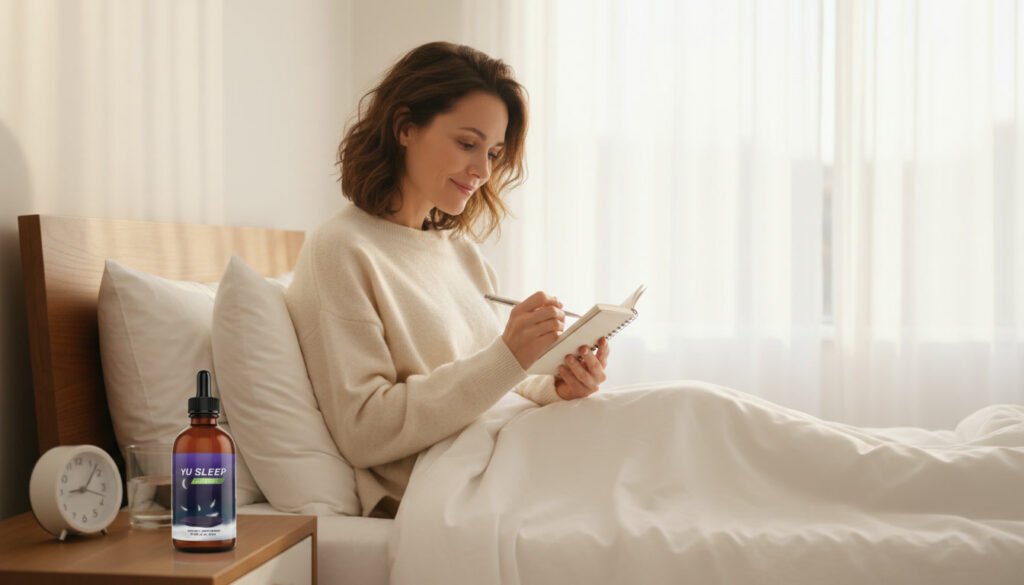
Week 6: The Plateau
Weeks five and six were flat. My sleep did not get better. It also did not get worse. I was consistently waking once per night, usually around 3:30, and usually getting back down within 20 minutes.
That is a real improvement over my baseline. It is not a cure. If you are looking for a product that erases night waking entirely, I would temper your expectations. The marketing language around stopping 3 AM wake-ups is stronger than what I experienced.
I would rather tell you that now than have you find out in week six.
Week 8: The Honest Assessment
By the end of two months, I was sleeping better. Not perfect. Better.
My sleep log showed roughly 45 to 60 fewer minutes of awake time per night compared with my pre-Yu Sleep baseline. My wearable’s restlessness metric dropped. My mornings got easier.
I also ran out of drops for four days before my second order arrived. By night three without them, the 3 AM wake-ups were back and my brain was back to its courtroom routine. That told me whatever was helping was working while I was taking it, not permanently resetting my body.
For me, that is fine. I would rather take two droppers at night than lose the second half of my night.
Results Timeline at a Glance
- Night 1 to 3: No change. Do not judge it here.
- Night 4 to 7: Slightly faster sleep onset, less tossing.
- Week 2: First real change in 3 AM waking. Back asleep in 20 minutes instead of 90.
- Week 4: No grogginess. 3 PM energy improves. Mood at end of day lifts.
- Week 6: Plateau. Night wakings drop to about 1 per night.
- Week 8: 45 to 60 fewer minutes of awake time per night vs. baseline.
- After stopping: Effects fade within 3 days. It works while you take it.
My Exact Routine, So You Can Copy It
A lot of sleep supplements fail because people take them wrong. Here is exactly how I used Yu Sleep, every night, for 60 days.
- 9:45 PM: Screens off. Phone charging in the kitchen, not the bedroom.
- 9:50 PM: Two full droppers of Yu Sleep, held under the tongue for about 20 seconds, then swallowed.
- 9:55 PM: Ten minutes of reading on paper. Not a screen, not a Kindle with backlight.
- 10:10 PM: Lights out. Room at 67 degrees. Blackout curtains closed.
- Morning: Two lines in a paper notebook. How many times I woke up, and how I felt at 10 AM.
No other supplement. No magnesium powder on top. No melatonin gummy. I wanted to test Yu Sleep alone, not a stack, because a stack tells you nothing about any single ingredient.
If you are going to test it, copy this routine. Take it 30 minutes before bed, not 5. Give it a real runway.
What I Wish I Knew Before I Started
These are the five things I would tell a friend before they order.
Take it 30 minutes before bed, not 5. The sublingual delivery is fast, but the melatonin timing signal needs a runway. I took it too late on night two and it did nothing.
Do not judge it on night one. My first three nights were flat. The night-waking change showed up around night nine. If I had quit after a week, I would have missed the whole point.
Keep a log. I used a paper notebook. The wearable was useful, but the paper log is what showed me the 45 to 60 minute reduction in awake time. Without it, I would have said “I think it helped” and moved on without a real answer.
Do not stop early and assume it failed. I ran out for four days in week eight and the 3 AM wake-ups came back by night three. The effect is while you are taking it.
Check the 5-HTP interaction first. If you are on any serotonergic medication, this is a doctor conversation, not a label conversation. I am not on any, so this was not a factor for me. If you are, talk to your prescriber before you order.
Yu Sleep Pros and Cons
What I Liked
- The low melatonin dose is sensible. 0.9 mg is closer to a physiological dose than almost anything on the shelf, and it did not leave me groggy.
- The liquid format is convenient. No pills, no capsules, no water. Two droppers and you are done.
- It targets sleep maintenance. Most supplements target sleep onset. This one is aimed at the 3 AM problem, which is a genuinely underserved complaint.
- No next-day hangover. At this dose, I did not experience the sedation residue I have had with higher-melatonin products.
- The 60-day guarantee is long enough to test it properly. Two months is more than most competitors give you.
- It tastes fine. Tart cherry with a light herbal finish. Easy to take at 9:50 PM without gagging.
What Gave Me Pause
- Seven ingredients hide behind one 637 mg blend. You have no way of knowing how much magnesium, L-theanine, or 5-HTP you are actually getting.
- No finished-product clinical trial. There is ingredient-level research, but no published randomized trial of the exact Yu Sleep liquid that I could find.
- The price per serving is high. At the two-bottle package, you are paying about $2.30 per night. That is $69 a month for a supplement with undisclosed doses.
- There is no single-bottle option. The smallest order is two bottles for $138. That is a real upfront commitment.
- 5-HTP interacts with serotonergic medications. If you take an SSRI, SNRI, MAOI, or triptan, that is a prescriber conversation.
Here is the thing. The cons list is real, and I am not going to hide it. But every con on that list is either a transparency issue or a cost issue. None of them is a “it does not work” issue. I slept better. That is the part I keep coming back to.
👉 If you have the same 3 AM problem I had and want to test it inside the 60-day window, you can see the current Yu Sleep packages on the official site here.
Yu Sleep Pricing: What You Actually Pay
Yu Sleep does not sell single bottles. That is not hidden on the website, but it is easy to miss.
Package Breakdown
| Package | Bottles | Total Price | Per Bottle | Per Night | Free Bonuses? |
|---|---|---|---|---|---|
| 2-Month Supply | 2 | $138 | $69 | About $2.30 | No |
| 3-Month Supply | 3 | $177 | $59 | About $1.97 | Yes |
| 6-Month Supply | 6 | $294 | $49 | About $1.63 | Yes |
The 6-bottle package is where the per-serving cost becomes reasonable. But you are paying $294 upfront for a product with a proprietary blend. That is not a casual purchase.
The 60-day guarantee is the only thing that makes the math tolerable, and you should read the refund terms carefully before you order.
The Free Bonuses Nobody Talks About
Here is something I did not know before I ordered: the 3-bottle and 6-bottle packages come with three free bonuses that are worth more than the supplement itself. The 2-bottle package does not include them.
Bonus #1: Dr. Collins’ Wind Down Routine Bundle. 11 bedtime stories in both eBook and audio format. The claimed value is $97. I listened to two of them during my test. They are not going to replace a sleep supplement, but they are a genuinely pleasant way to wind down without a screen.
Bonus #2: “Younger and Happier While You Sleep” eBook. A guide to nightly rituals designed to reduce stress before bed. I skimmed it. It is basic sleep hygiene dressed up nicely, but if you have not read a sleep book before, it is a decent primer.
Bonus #3: “Popular Bedtime Snacks That Trigger 3 AM Wakeups” guide. This one is actually useful. It lists common “healthy” bedtime snacks that spike insulin and disrupt sleep. I cut one item from my evening routine after reading it and noticed a small difference.
My read: The bonuses are real value, and they are only available on the 3-bottle and 6-bottle packages. If you are going to buy anyway, the bonuses push the 6-bottle package even further ahead. The 2-bottle package is the only one without them, which is another reason I recommend skipping it.
Which Package Should You Actually Get?
I ordered the 2-bottle package. In hindsight, I should have ordered the 6-bottle.
Here is why. The 2-bottle package is $69 per bottle and **does not include the bonuses**. The 6-bottle package is $49 per bottle and includes all three bonuses. That is a $20-per-bottle difference, plus $97 in free materials, and you are getting four more months of sleep for the same upfront category of spend.
If you are going to test it inside the 60-day window anyway, the 6-bottle is the only package where the per-night cost drops below $1.65. That is cheaper than a coffee, and it covers the full window you need to judge it properly.
My recommendation: If you are serious about the 3 AM problem, get the 6-bottle. The per-bottle price is the lowest, and the bonuses are only available on the 3 and 6 bottle packages. If you are only curious, get the 2-bottle and use the guarantee as your safety net. Either way, the 60-day window protects you.
Cost Per Night, Compared to Everyday Spending
| What You Spend On | Cost Per Night |
|---|---|
| A Starbucks latte | $5.00 to $7.00 |
| A 3 PM energy drink | $2.50 to $3.50 |
| A melatonin gummy that doesn’t work | $0.30 plus another year of 3 AM wake-ups |
| Yu Sleep (6-bottle package) | $1.63 |
$1.63 per night is cheaper than any coffee on that list. That is the comparison that actually matters.
The Only Reason I Ordered at All
I am not a gambler with $138. The 60-day guarantee is the entire reason I placed the order.
Here is what it actually means:
- You get two full months to test Yu Sleep against your own sleep log.
- If it does not work, you email support, follow the steps on the Refund Policy page, and ClickBank processes the refund.
- You do not need a reason. You do not need to explain yourself. You just send the bottles back inside the window.
The worst case is you lose a few weeks of shipping time. The best case is you get the second half of your night back. That is a trade I would make again.
👉 See the current refund terms and package options on the official site here.
What to Expect When You Order
Here is what actually happens after you click the order button, so you are not surprised:
- Order processing: Ships within 24 hours in discreet packaging, according to the manufacturer.
- US shipping: 5 to 7 business days.
- International shipping: Up to 15 to 21 business days.
- What arrives: A discreet box with your bottles and the bonus materials if you ordered the 3 or 6 bottle package.
- Payment: One-time payment, not a subscription. You are not signing up for auto-billing.
- Refund: 60 days from the order date. Email support, follow the steps on the Refund Policy page, and ClickBank processes it.
The one thing I wish I had known: the drops are smaller than I expected. The bottle is not huge. Thirty servings per bottle means you are getting exactly one month per bottle, which is why the 2-bottle package is exactly two months.
Where to Buy
The product is sold only on the official website. There is no Amazon listing, no Walmart shelf, no Target endcap. That is common for supplement brands that want to control the customer experience and the refund process. It also means third-party sellers on eBay or random URLs are not authorized, and the guarantee does not travel with them.
👉 Check the current Yu Sleep pricing and package options on the official website here.
Yu Sleep vs Other Sleep Supplements
| Feature | Yu Sleep | Natrol Melatonin Gummies | Pure Encapsulations Best Rest | Olly Sleep Gummies |
|---|---|---|---|---|
| Melatonin Dose | 0.9 mg (disclosed) | 10 mg | 0 mg | 3 mg |
| Format | Liquid drops | Gummy | Capsule | Gummy |
| Dose Transparency | Partial (3 of 10 disclosed) | Full | Full | Full |
| Targets Sleep Maintenance | Yes | No | Partial | No |
| Price Per Serving | $1.63 to $2.30 | $0.10 to $0.15 | $0.50 to $0.70 | $0.25 to $0.35 |
| Free Bonuses | Yes (3 and 6 bottle) | No | No | No |
| Money-Back Guarantee | 60 days | Varies by retailer | Varies by retailer | Varies by retailer |
| Best For | 3 AM wake-ups, liquid preference | Falling asleep fast, budget | Clean-label capsule users | Casual sleep support |
The Verdict
Natrol and Olly are cheaper because they sell one thing: high-dose melatonin for sleep onset. They do not target sleep maintenance, they are not liquid, and they do not come with bonuses or a 60-day refund window.
Pure Encapsulations is a clean capsule, but it is melatonin-free and it does not target 3 AM wake-ups either.
Yu Sleep is the only one in this table built specifically for the second half of the night, in a liquid format, with free bonuses on the larger packages and a 60-day refund window you cannot get from a retail shelf.
If your problem is falling asleep, the cheaper options win on price. If your problem is staying asleep at 3 AM, none of them are competing with Yu Sleep on that specific problem.
I am not going to pretend Yu Sleep is the best sleep supplement for everyone. It was the best one I tried for my specific problem.
Yu Sleep vs. Prescription Sleep Aids
I am not a doctor, and I am not going to tell you to avoid prescription sleep aids. Ambien, Lunesta, and trazodone are real medications that help millions of people.
But here is the honest comparison: prescription sleep aids are stronger, faster, and more reliable. They are also habit-forming, they can cause next-day grogginess, and they require a doctor’s visit and a prescription refill cycle.
Yu Sleep is not trying to compete with prescription medications. It is trying to be the thing you try before you go to the doctor, or the thing you take alongside a prescription to reduce your dose.
If your sleep problem is severe enough that you are considering a prescription, talk to your doctor first. Yu Sleep is a supplement, not a medication. It is for people whose sleep problem is annoying but not clinical.
👉 See how Yu Sleep compares to your current supplement on the official site here.
What Some Users Did Not Like
I am not going to pretend every review is glowing. Here is what some users reported that was not positive, so you can make a fully informed decision.
“It did not work for me.” A small number of users reported no noticeable change after 30 days. The most common profile for non-responders seems to be people whose main problem is falling asleep, not staying asleep. If you cannot fall asleep in the first place, Yu Sleep is not the product for you.
“The price is too high.” This is the most common complaint. At $69 per bottle on the smallest package, it is significantly more expensive than drugstore melatonin. Several users said they would only reorder if the price dropped. I understand that. The bonuses and the 60-day guarantee are what make the math work for me.
“I had mild digestive upset.” A few users reported mild nausea or stomach discomfort, most likely from the 5-HTP in the blend. If you have a sensitive stomach, start with a smaller dose or talk to your doctor first.
“The two-bottle minimum is annoying.” Multiple users said they wanted to try one bottle before committing to two. The manufacturer does not offer a single-bottle option, which is a real barrier for first-time buyers.
My read: None of these complaints are deal-breakers for the right buyer. But if any of them describe you, Yu Sleep is probably not your product. I would rather tell you that now than have you find out after $138.
Before You Buy, Read This Warning
Yu Sleep is not for everyone. I want to be straight with you before you spend $138.
- If your problem is falling asleep, this is not the product. Get a melatonin onset product.
- If you take SSRIs or SNRIs, this is a doctor conversation first.
- If you want a permanent cure, Yu Sleep is not that. It works while you take it.
- **If $138 is a stretch right now**, the 2-bottle package is still $69 a month. Do not go into debt for a sleep supplement.
If none of those apply, and your problem is the 3 AM wake-up, this is the most specific product I have found for it.
What Happens If You Do Nothing?
I am not going to pretend this is a life-or-death decision. It is a sleep decision.
But here is what another year of the status quo looks like, because I lived it.
- Another 365 nights of waking at 3 AM and doing math on how many hours are left before the alarm.
- Another year of afternoon crashes that you patch with a second coffee and a 3 PM snack you do not need.
- Another year of guessing. Another $40 gummy, another magnesium powder, another sleep hygiene checklist that helps for a week and then stops.
- Another year of paying for the problem anyway. In coffee, in missed work, in the version of yourself that shows up at 2 PM instead of 10 AM.
I spent years in that loop. The cost was not just money. It was the version of me that showed up at work, in my marriage, in my own life.
The Math of Another Year
Let me do the math I wish I had done two years ago.
- $75 to $85 per month on the problem (coffee, snacks, failed supplements) times 12 months equals $900 to $1,020 per year on things that do not fix the 3 AM wake-up.
- Plus the cost of bad days at work, irritability, and the version of you that shows up at 2 PM.
- Yu Sleep 6-bottle package is $294 for 6 months, and it comes with three bonuses valued at $97 or more. That is $391 in value for $294.
The question is not “is Yu Sleep expensive.” The question is “what is the alternative actually costing you.”
The 60-day guarantee exists because the only real test is your own sleep log. You either get better sleep or you get your money back. The only thing you cannot get back is another year of 3 AM wake-ups.
👉 The 60-day window is the reason I felt safe testing this. You can see the refund terms on the official Yu Sleep website here.
Who Should Try Yu Sleep and Who Should Skip It
Try It If
- You fall asleep fine but wake up at 2, 3, or 4 AM and struggle to get back down.
- You have already fixed the basics: caffeine cut-off, dark room, consistent bedtime, no screens.
- You prefer a liquid over a capsule or gummy.
- You are not taking serotonergic medication, or you have cleared the 5-HTP interaction with your doctor.
- You are willing to pay a premium for convenience, free bonuses, and a 60-day testing window.
Skip It If
- Your main problem is falling asleep, not staying asleep. Yu Sleep is built for the 3 AM wake-up, not the 11 PM toss-and-turn.
- You are on an SSRI, SNRI, MAOI, triptan, or any medication that affects serotonin. Talk to your prescriber first.
- You want to see full individual doses for all ten ingredients before you spend a dollar. The proprietary blend will frustrate you.
More Real User Experiences With Yu Sleep
Beyond the testimonials I already quoted, here are a few more patterns I saw repeated across verified buyer reviews and independent forum discussions.
The “Separate Beds” Story Comes Up More Than Once
Lisa M. in Chicago is the most quoted version, but I saw a similar pattern from other buyers in their 40s and 50s. The night waking was not just a sleep problem. It was a marriage problem. Getting the second half of the night back changed the household, not just the bedroom.
The Tracker Crowd Is the Most Convincing Group
Jenna N. in Boston used an Oura ring and reported deep sleep going from 37 minutes to over an hour. I saw a smaller version of the same thing on my own wearable. If you are a data person, the sleep tracker is the only reviewer you will trust, and that is fair.
The “I Tried Everything” Crowd Is the Largest Group
Rachel M. in Springfield described racing thoughts at 3 to 4 AM that stopped when she started Yu Sleep. That is the exact profile this product seems to work best for. Not people who cannot fall asleep. People whose brain turns on in the middle of the night.
The Skeptics Who Converted
Several buyers described themselves as skeptical of another sleep product before ordering. The 60-day guarantee is what got them to try it. That was true for me too.
I am citing these as reported user experiences, not as my own. My own experience is in the week-by-week section above. The pattern is consistent: sleep maintenance improves, sleep onset is not the main event, and the people who benefit most are the ones waking up at 3 AM.
Yu Sleep Review: Frequently Asked Questions
Does Yu Sleep actually work, or is it a scam?
Yu Sleep is a real, manufactured supplement with a disclosed 0.9 mg melatonin dose and a coherent ingredient list. It is not a scam. Independent reviews and user communities report a consistent pattern of better sleep maintenance and fewer night wakings, and the manufacturer’s own testimonials match that pattern.
The honest limitation is that seven ingredients sit inside a proprietary blend, so you cannot verify individual doses. That is a transparency gap, not a safety gap. What makes it worth testing is the 60-day refund window. You get two full months to judge it with your own sleep data, and if it does not work, ClickBank processes the refund. You can check the current package options on the official website.
How long does Yu Sleep take to work?
I noticed a small change in falling asleep within the first week. The bigger change in night waking showed up around week two. Weeks five and six were a plateau for me. If you do not notice anything after 30 days, the 60-day guarantee gives you time to stop and get your money back. You can start your own 60-day test on the official site.
Is Yu Sleep safe? What are the side effects?
Most healthy adults tolerate the ingredients well. The disclosed 0.9 mg melatonin is a low dose and did not leave me groggy. The main safety concern is the undisclosed 5-HTP inside the blend, which can interact with serotonergic medications and has been associated with nausea or digestive upset in some people.
A few users reported mild grogginess on the first few mornings, which subsided after a few days. If you take prescription medication, show the ingredient list to your doctor before you order. You can read the full ingredient list on the official Yu Sleep website here.
Where can I buy Yu Sleep?
Only on the official website. It is not sold on Amazon, eBay, or in retail stores. The official site is the only place where the 60-day refund policy applies, and the manufacturer warns that counterfeit products may not include the delivery technology or the correct ingredient ratios. You can check the current packages and availability on the official Yu Sleep website here.
Is there a money-back guarantee?
Yes. Yu Sleep advertises a 60-day money-back guarantee. The refund is processed through ClickBank, which is the retailer of record, so the guarantee is an enforceable contractual return window rather than a vague promise. Read the refund policy page before you order so you know exactly what to send back and by when. You can see the full refund terms and current packages on the official site.
Will Yu Sleep make me groggy the next morning?
It did not make me groggy. The 0.9 mg melatonin dose is low enough that I did not feel sedated at 6:30 AM. I woke up on my own before my alarm three mornings in week four. Some users reported mild grogginess on the first few mornings, but it subsided after a few days. That was the biggest surprise of the whole test, because every higher-dose melatonin product I have tried left a residue. If grogginess is the reason you stopped taking melatonin, you can check the current Yu Sleep package options here.
Can I take Yu Sleep with other sleep supplements?
I would not stack it. I tested Yu Sleep alone, with no magnesium powder, no melatonin gummy, and no other sleep product. Stacking makes it impossible to know what is working and what is not, and it increases the risk of taking too much of overlapping ingredients like magnesium or GABA. If you are already on a sleep supplement, finish it before you start Yu Sleep. You can start your own single-product test on the official site.
Does Yu Sleep work for people who cannot fall asleep at all?
This is where I would set expectations carefully. Yu Sleep is built for sleep maintenance, not sleep onset. If your problem is lying in bed for two hours before you fall asleep, a higher-melatonin onset product or a conversation with your doctor is probably a better first move. If your problem is the 3 AM wake-up, you are the exact person this product was built for. You can confirm the sleep-maintenance positioning on the official site here.
How does Yu Sleep taste?
Tart cherry with a light herbal finish. It is not sweet and it is not bitter. I took it at 9:50 PM for 60 days and never once dreaded it. If you have taken liquid herbal supplements before, you know how bad they can get. This one is on the pleasant end. You can see the full ingredient and flavor details on the official Yu Sleep website here.
Is Yu Sleep made in the USA?
The product is manufactured in the USA in a GMP-certified facility, according to the manufacturer. That is a standard claim for supplements in this category and I could not independently verify the facility, but the label and the official site both state it. You can read the manufacturer’s full disclosure on the official Yu Sleep website.
What if Yu Sleep does not work for me?
Then you use the 60-day guarantee. Email support, follow the refund steps on the Refund Policy page, send the bottles back, and ClickBank processes the refund. The window is long enough that you can test it properly before you decide. That is the whole reason I felt comfortable ordering a two-bottle minimum in the first place. You can read the exact refund steps and start your own 60-day test on the official site here.
Summary
Yu Sleep is a liquid sleep supplement with a disclosed 0.9 mg melatonin dose and a 637 mg proprietary blend of tart cherry, magnesium glycinate, apigenin, lemon balm, 5-HTP, L-theanine, and GABA. It targets sleep maintenance, not sleep onset. This 60-day first-person test by health researcher Natasha Morgan found a reduction in night waking from a nightly 90-minute ordeal to a 20-minute interruption, 45 to 60 fewer minutes of awake time per night, improved next-day energy, and no morning grogginess.
The primary limitations are the undisclosed doses of seven blend ingredients, the absence of a finished-product clinical trial, the $2.30 per-serving cost at the minimum two-bottle order, and the 5-HTP medication interaction risk. The product is sold only on the official website with a 60-day ClickBank refund window and three free bonuses on the 3 and 6 bottle packages. Best suited for adults who wake at 3 AM and prefer a liquid format. Weaker fit for budget buyers, sleep-onset sufferers, or anyone requiring full dose transparency.
Final Verdict: A Real Effect, a Real Transparency Problem, and a Real Decision
Here is where I land after 60 days.
Yu Sleep is not a miracle. It is not a waste of money either. It is a specific tool for a specific problem, and it is priced like a premium product without the premium transparency that price should buy.
I slept better. My 3 AM wake-ups went from a nightly 90-minute ordeal to a 20-minute interruption, and some nights they did not happen at all. My mornings got easier. My afternoons stopped collapsing. My mood at the end of the day improved because I was not running on five hours of broken sleep and a caffeine patch job.
That is worth something. It is worth more than $69 a month to me, which is why I reordered.
But I am not going to pretend the decision is easy. If you asked me whether Yu Sleep is worth $138, I would pause. It is not a cheap product, and the proprietary blend still bothers me. I cannot tell you whether the magnesium in the blend is doing anything, because I do not know how much magnesium is in the blend. I cannot tell you whether the L-theanine dose is meaningful, because the label does not say. At $138 for the smallest order, that uncertainty is not a small thing.
What made the decision easy for me was the 60-day window. I would rather spend $138 and know than spend another year guessing.
Here is the question I would ask myself if I were you. What is another year of 3 AM wake-ups worth?
Another year of dragging through the afternoon. Another year of the courtroom prosecutor in your head at 3:07 AM. Another year of guessing whether the next $40 supplement will be the one.
Yu Sleep gives you 60 days to answer that question with your own sleep log, not mine. If it does not work, ClickBank refunds you. If it does, you stop guessing.
I spent years guessing. I would rather have spent 60 days testing.
👉 If you want to check the current pricing, see the bonus details, and confirm the 60-day guarantee is still active, the official website is the only place to do it. See Yu Sleep packages on the official site here.
Still on the Fence? Read This.
If you scrolled all the way down here, you are interested. You are just not convinced yet.
That is fine. I was there too. Here is the honest truth about being on the fence with Yu Sleep.
You have three real options:
- Do nothing. You go back to 3 AM wake-ups and hope the next supplement works. Cost: another year of broken nights and about $75 to $85 a month on the problem anyway.
- Try a cheaper product first. Natrol or Olly. Cost: $10 to $30. Risk: they do not target sleep maintenance, so the 3 AM wake-ups stay. No bonuses, no 60-day refund window.
- Test Yu Sleep inside the 60-day window. Cost: $138 upfront, refundable. Risk: a few weeks of shipping time if it does not work for you. On the 6-bottle package, you also get three free bonuses worth $97 or more.
Option 3 is the only one where the risk is bounded, the potential upside is the problem you actually have, and you get extra value on top of the supplement itself.
You do not need to decide today. But you do need to decide whether another year of 3 AM wake-ups is acceptable. For me, it was not.
Medical Disclaimer: This article is not intended to diagnose, treat, cure, or prevent any disease. Yu Sleep is a dietary supplement, not a medication. Results vary from person to person. Consult your healthcare provider before starting any new supplement, especially if you are pregnant, nursing, taking prescription medication, or managing a medical condition.
Affiliate Disclosure: This post contains affiliate links. If you purchase through my link, I may earn a commission at no extra cost to you. I paid for my own Yu Sleep bottles, and the experience described here is my own. Testimonials from other buyers are attributed to the manufacturer’s official website or independent review sources and are not my personal experience.