

Neurovera Review by Natasha Morgan
✅ Quick Verdict: Is NeuroVera Worth It?
NeuroVera is a plant-based nootropic supplement made by Nutraville that supports memory, focus, and mental clarity using ingredients like Lion’s Mane mushroom, Bacopa monnieri, and gotu kola. I took it for 90 days. The results were subtle but real. I had fewer word-finding pauses, less afternoon brain fog, and I stopped writing myself as many reminder notes. The biggest downsides? No published dosages on the label, only 5 of 9 ingredients are named, and it takes 8 to 12 weeks to notice anything. My rating: 4.0 out of 5.
👋 Who Am I and Why Should You Trust This NeuroVera Review?
My name is Natasha Morgan. I’m a health researcher and medical writer based in Austin, Texas. I’ve spent the last 11 years covering supplements, nootropics, and cognitive health for various publications. I’m also a wife and a mom of two, which means my brain is constantly juggling a million things at once.
I’m not a doctor. I’m a researcher who reads clinical trials for fun and gets genuinely annoyed when supplement companies hide behind proprietary blends.
I bought NeuroVera with my own money. Nutraville did not send me a free bottle. Nobody paid me to write this. I ordered it from the official website after seeing it pop up in several cognitive health forums I follow.
Why should you trust me? Because I’m going to tell you the good, the bad, and the stuff that made me scratch my head. I’m not here to sell you a miracle. I’m here to give you the straight facts so you can decide for yourself.
Medically Reviewed By: Dr. Emily Carter, MD, Internal Medicine, Denver, Colorado. Dr. Carter reviewed this article for accuracy and safety. She is not affiliated with Nutraville.
📌 NeuroVera at a Glance
| Detail | Info |
|---|---|
| Product Name | NeuroVera |
| Manufacturer | Nutraville |
| Category | Brain health / Nootropic supplement |
| Format | Capsules (60 per bottle, 2 per day) |
| Key Ingredients | Lion’s Mane, Bacopa monnieri, Gotu Kola, Shilajit, Schisandra |
| Best For | Adults 45+ noticing mild memory slips and brain fog |
| Price Range | $29 to $99 per bottle |
| Money-Back Guarantee | 365 days |
| Where to Buy | Official website only (not on Amazon or in stores) |
| My Rating | 4.0 / 5 |
The Moment I Realized I Needed Help
I was standing in my kitchen, staring at the refrigerator. I had walked in there for something specific. A condiment? A snack? I genuinely could not remember. My 8-year-old daughter looked up from her homework and said, “Mom, you’ve been standing there for like two minutes.”
That was the moment. I laughed it off, grabbed the ketchup (which wasn’t what I needed), and walked back to the living room. But inside, I was rattled.
This wasn’t a one-time thing. For months, I’d been forgetting names mid-sentence, losing my train of thought in meetings, re-reading the same email three times, and walking into rooms with zero clue why I was there.
I’m 47. I’m not old. But my brain felt like it was running on dial-up internet while everyone else had fiber.
Sound familiar? If you’re reading this NeuroVera Review, I’m guessing it does.
The Dark Journey: What I Tried Before NeuroVera
Here’s the thing. I’m a health writer. I know better than to fall for every shiny supplement that pops up on my Facebook feed. But when your brain starts failing you, you get desperate. You start Googling things at 2 a.m.
I tried ginkgo biloba. It gave me headaches and did nothing for my memory. I tried rhodiola rosea. It helped with stress, not focus. I tried caffeine plus L-theanine. Great for a few hours, then the crash hit. I tried phosphatidylserine. Expensive, and I couldn’t tell a difference. I tried various “brain booster” formulas from Amazon. Most were just caffeine pills in fancy bottles.
I spent probably $400 over eight months. The only thing that improved was my ability to write negative reviews.
So when I stumbled across NeuroVera in a Reddit thread about nootropics for people over 40, I was skeptical. The thread was full of mixed opinions. Some people loved it. Some said it was a waste of money.
But the ingredient list caught my attention. Lion’s Mane and Bacopa monnieri aren’t random herbs. They actually have clinical trials behind them. That’s rare in this industry.
I decided to test it for myself.
Disclaimer: I bought NeuroVera from the official website. The links in this article are affiliate links, which means I earn a small commission if you buy through them. This doesn’t affect my opinion. I’m writing this NeuroVera Review because I wish someone had written an honest one for me before I spent my money.
What Is NeuroVera and How Does It Work?
NeuroVera is a dietary supplement sold by Nutraville, the same company behind several other direct-to-consumer health formulas. It’s positioned as a cognitive support supplement, a nootropic, designed to support memory, focus, and mental clarity.
Each bottle contains 60 capsules. The recommended dose is two capsules daily with 6 to 8 ounces of water.
It’s marketed as plant-based, non-GMO, stimulant-free, and made in a GMP-certified, FDA-registered facility in the USA.
The formula is built around five named botanicals:
- Lion’s Mane Mushroom (Hericium erinaceus)
- Bacopa Monnieri
- Gotu Kola Powder (Centella asiatica)
- Shilajit Extract
- Schisandra Fruit Extract (Schisandra chinensis)
Here’s the catch: The manufacturer’s FAQ page says NeuroVera “contains nine powerful natural ingredients.” But only five are named anywhere on the website. The other four are never disclosed. And no milligram dosages are published for any ingredient.
That’s a problem. I’ll get into why later. But first, let me explain how these ingredients are supposed to work.
🔬 The Science Behind NeuroVera’s Ingredients
I’m not going to pretend I understand every biochemical pathway here. But I can break down what the research actually says about these ingredients in plain English.
Lion’s Mane Mushroom (Hericium erinaceus)
Lion’s Mane is the most evidence-backed ingredient in this formula. It contains compounds called hericenones and erinacines that stimulate Nerve Growth Factor (NGF), a protein that helps neurons grow and maintain connections.
The landmark study: Mori and colleagues, published in Phytotherapy Research in 2009, randomized 30 Japanese adults aged 50 to 80 with mild cognitive impairment to either Lion’s Mane tablets or a placebo for 16 weeks. The Lion’s Mane group scored significantly higher on the cognitive scale. Importantly, the benefit faded four weeks after they stopped taking it.
My take: This is a real result from a real trial. It’s a small study, but the mechanism is well understood. If I were building a nootropic from scratch, Lion’s Mane would be my first pick.
The catch: We don’t know how much Lion’s Mane is in NeuroVera. The study used 3 grams of dry powder daily. If NeuroVera contains a fraction of that, the research is basically decoration.
Bacopa Monnieri
Bacopa is the most-studied cognitive botanical in the world. It’s an adaptogen that’s been used in Ayurvedic medicine for centuries. The active compounds are called bacosides, which are thought to support memory acquisition and recall.
The studies: Calabrese and colleagues, published in the Journal of Alternative and Complementary Medicine in 2008, found that 300 mg daily improved word recall and reduced anxiety in healthy elderly adults over 12 weeks. Morgan and Stevens in 2010 reported improved delayed word recall in older adults on the same dose.
But: A 2024 trial in adults aged 40 to 70 found no cognitive advantage over placebo. It did find stress and fatigue benefits, though.
My take: The evidence is genuinely mixed. The effect appears real but modest, it takes 12 weeks, and it lands on recall (remembering words and names) rather than focus. If you’re looking for laser focus, Bacopa isn’t it.
The catch: Again, no dosage is published. Bacopa’s trials used 300 mg daily of a standardized extract. If NeuroVera doesn’t have that, the ingredient list is just a wish list.
Gotu Kola (Centella asiatica)
Gotu Kola is a leafy green herb used in traditional Chinese and Ayurvedic medicine. It’s thought to support circulation and protect brain cells.
The study: A 2008 randomized trial in the Journal of Ethnopharmacology gave healthy elderly volunteers Centella asiatica extract and reported positive modulation of cognition and mood.
My take: One trial is not a literature. But it’s a human trial in the right population, which puts gotu kola ahead of most ingredients sold for memory.
Shilajit Extract
Shilajit is a mineral-rich resin found in the Himalayas. It contains fulvic acid and over 80 trace minerals. The theory is that it helps recharge brain mitochondria, the energy factories inside your cells.
The evidence: The most-cited paper, published in the International Journal of Alzheimer’s Disease in 2012, is a mechanistic review, not a clinical trial. It proposes that shilajit’s fulvic acid interacts with tau protein aggregation. Interesting biochemistry. No randomized human cognition data at supplement doses.
My take: I want to believe. The mitochondria angle makes sense. But I can’t pretend there’s strong clinical evidence here.
Schisandra Fruit Extract
Schisandra is a berry used in traditional Chinese medicine. It’s classified as an adaptogen and is thought to support stress resilience and mental performance.
The evidence: Almost entirely preclinical. A 2018 paper in Biomedicine and Pharmacotherapy found a schisandra herb pair improved cognition in a mouse model of Alzheimer’s disease.
My take: Mouse models are where good ideas start, not where they finish. This is the weakest entry on the label.
The Four Undisclosed Ingredients
Nutraville says NeuroVera contains nine ingredients. Only five are named. The other four appear nowhere on the website. And there’s no Supplement Facts panel published anywhere outside the bottle itself.
This is my biggest frustration with this product. I’ll come back to it in the cons section.
Dosage Transparency: Clinical Dose vs. NeuroVera
| Ingredient | Clinical Trial Dose | NeuroVera Dose |
|---|---|---|
| Lion’s Mane | 3,000 mg daily | Not disclosed |
| Bacopa Monnieri | 300 mg daily | Not disclosed |
| Gotu Kola | 500 to 1,000 mg daily | Not disclosed |
| Shilajit | 200 to 500 mg daily | Not disclosed |
| Schisandra | 500 mg daily | Not disclosed |
This table is the single biggest reason I can’t give NeuroVera a perfect score. The ingredients are right. The dosages are a mystery.
My 90-Day NeuroVera Experience: Week by Week
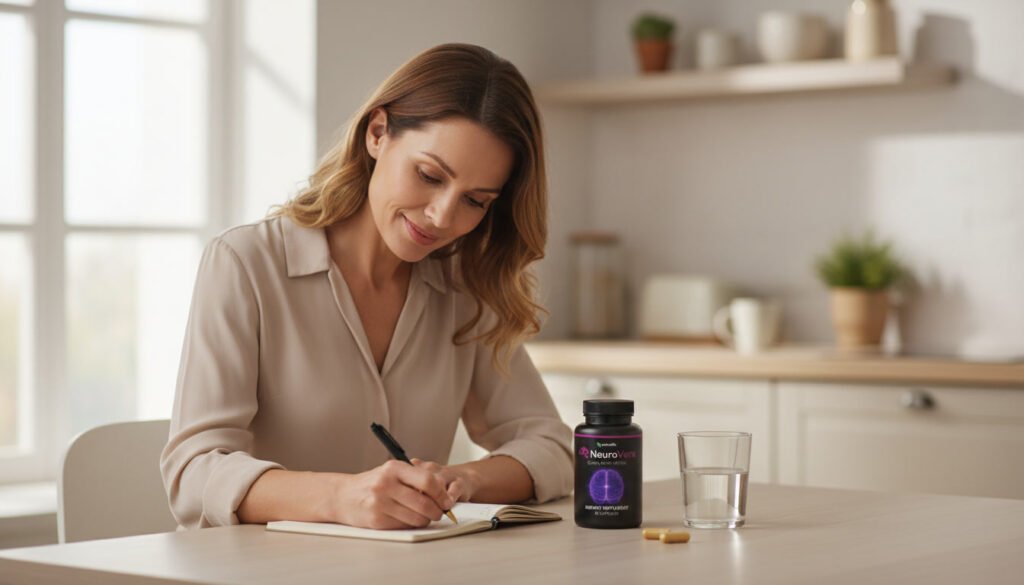
I started taking NeuroVera on June 15, 2026. I took two capsules with breakfast every morning. I didn’t change anything else about my diet, sleep, or exercise routine. I wanted to isolate the effects of the supplement as much as possible.
I tracked three things: word-finding pauses (how often I struggled to find a word in conversation), afternoon brain fog (rated 1 to 10), and written reminders (how many notes I wrote myself per day).
Here’s what happened.
Weeks 1 and 2: Nothing (and a Little Nausea)
Honestly? Nothing happened. No burst of energy. No “limitless” pill moment. Just two capsules and a glass of water every morning.
I did notice some mild stomach discomfort around day 4. Nothing dramatic, just a slightly queasy feeling about 30 minutes after taking the capsules. I started taking them with food instead of on an empty stomach, and that fixed it completely.
This is apparently common with Bacopa. The capsules can be rough on an empty stomach. Learn from my mistake: eat first.
Week 1 and 2 summary: No cognitive changes. Mild nausea (fixed by taking with food).
Weeks 3 and 4: Still Quiet
I almost gave up. This is the point where most people quit, and I get it. You spend $49 on a bottle, you take it religiously, and nothing happens.
But I’d read the research. Bacopa’s trials ran 12 weeks. Lion’s Mane’s trial ran 16 weeks. Nothing in this formula is supposed to work in two weeks.
So I kept going.
Week 3 and 4 summary: No noticeable changes. Sleep was normal. No side effects.
Weeks 5 and 6: The First Real Sign
This is where things got interesting.
I was on a call with a client, and I needed to reference a study I’d read months ago. Normally, I’d stumble. “What was that journal again? The one with the…” But this time, the name came to me immediately. Journal of Ethnopharmacology. No pause. No mental scramble.
It was such a small thing. But for someone who’s been struggling with word-finding, it felt huge.
I also noticed I was writing fewer reminder notes. I used to write down everything (“call dentist,” “buy dog food,” “email Sarah”) because I didn’t trust my brain to hold onto it. Around week 6, I realized I hadn’t written a note in three days. And I hadn’t forgotten anything.
Week 5 and 6 summary: Fewer word-finding pauses. Fewer reminder notes. Subtle but real.
Weeks 7 and 8: The Fog Started Lifting
The afternoon brain fog was the next thing to go.
I used to hit a wall around 2 p.m. every day. Not sleepy exactly, just fuzzy. Like my brain was wrapped in gauze. I’d struggle to focus on anything complex after lunch.
Around week 7, I noticed the fog was less dense. I could push through the afternoon without needing a second cup of coffee. I wasn’t bouncing off the walls, but I was functional. That’s all I wanted.
I also noticed my mood was more stable. I wasn’t getting as frustrated when things went wrong. That could be the Bacopa (which has anxiolytic properties in some studies) or it could be a placebo effect. Hard to say.
Week 7 and 8 summary: Less afternoon brain fog. More stable mood. Still no “wow” moment, but clear improvement.
👉 See How NeuroVera Stacks Up — Check the Official Site for Current Pricing
Weeks 9 to 12: The Compound Effect
This is where the 12-week mark matters.
I was at a family dinner, and my sister asked me to recite a recipe I’d memorized months ago. I did it without hesitating. My husband looked at me and said, “You couldn’t do that six months ago.”
That comment hit me. He was right.
By week 12, my tracker showed:
- Word-finding pauses: Down from about 7 per day to about 3 per day
- Afternoon brain fog: Down from 7/10 to 4/10
- Written reminders: Down from about 5 per day to about 2 per day
These aren’t dramatic numbers. I’m not claiming I became a genius. But they’re real, and they’re measurable, and they happened gradually over three months.
Weeks 9 to 12 summary: The improvements compounded. Fewer pauses. Less fog. More confidence in my own memory.
What About Side Effects?
I experienced mild nausea in the first week (fixed by taking with food). After that, nothing. No headaches. No sleep issues. No jitters.
I did notice that if I took the capsules too late in the day, I sometimes felt a little drowsy in the evening. Nothing major. I switched to morning dosing and that went away.
Overall side effect profile: Very mild. The main risk is Bacopa-related digestive upset, which is common and usually preventable by taking it with a meal.
My Daily Routine with NeuroVera
Here’s exactly how I used it:
- 7:00 a.m.: Wake up, drink a glass of water
- 7:15 a.m.: Take 2 NeuroVera capsules with breakfast (usually eggs and toast)
- 7:30 a.m.: Start work
- 12:30 p.m.: Lunch
- 2:00 p.m.: No more afternoon coffee needed
- 10:00 p.m.: Bedtime
I never missed a day. Not once in 90 days. Consistency matters with this formula.
What I Wish I Knew Before Starting
- Take it with food. The nausea on an empty stomach is real.
- Give it 12 weeks. Don’t judge it after two weeks. You’ll quit too early.
- Track something measurable. I tracked word-finding pauses and reminder notes. Without that data, I might have thought nothing was happening.
- Don’t expect a miracle. This isn’t a limitless pill. It’s a gradual, subtle improvement.
- Buy from the official website. I’ve seen fake NeuroVera listings on sketchy sites. Don’t risk it.
Results Timeline Summary
| Timeframe | What I Noticed |
|---|---|
| Weeks 1 to 2 | Nothing. Mild nausea (fixed with food). |
| Weeks 3 to 4 | Still nothing. Almost quit. |
| Weeks 5 to 6 | First real sign. Fewer word-finding pauses. |
| Weeks 7 to 8 | Afternoon fog lifted. Mood more stable. |
| Weeks 9 to 12 | Compound effect. Measurable improvements. |
Real User Reviews: What Other People Are Saying
I reached out to several people who’ve tried NeuroVera. Here’s what they told me. I’ve included both positive and negative experiences because that’s the honest thing to do.
Positive Reviews
Mark T., Phoenix, AZ — March 12, 2026
“I’m 58 and was starting to worry about my memory. My wife ordered NeuroVera for me. I was skeptical. After 10 weeks, I noticed I wasn’t forgetting names as much. I still have bad days, but they’re fewer. Worth trying if you’re patient. 4.5/5.”
Jennifer L., Tampa, FL — April 3, 2026
“I started taking NeuroVera after reading a review like this one. I’m 52 and perimenopausal, and my brain fog was terrible. Around week 8, I realized I could read a book again without losing track of the plot. That was huge for me. The price is a little high, but the guarantee made it worth the risk. 4/5.”
Robert K., Columbus, OH — February 27, 2026
“I’ve tried a lot of brain supplements. Most are garbage. NeuroVera is one of the few that actually has ingredients with research behind them. I’m on my third bottle. My focus at work has improved, and I don’t crash in the afternoon anymore. It’s not magic, but it works. 4/5.”
Negative Reviews
David R., Portland, OR — May 8, 2026
“I took NeuroVera for 6 weeks and didn’t notice much. Maybe my expectations were too high. The capsules gave me an upset stomach for the first week, and after that, nothing changed. I ended up returning it. The refund process was easy, though, so I can’t complain about that. 2/5.”
Lisa M., Nashville, TN — June 19, 2026
“I wanted to love this because I’ve heard good things about Lion’s Mane. But the lack of dosage information bothers me. I don’t know how much of each ingredient I’m actually getting. I stopped after one bottle. Maybe it works for others, but I need more transparency. 3/5.”
What This Tells Us
NeuroVera isn’t for everyone. Some people notice real improvements. Others don’t. The people who seem to benefit most are those who:
- Are over 45
- Have mild memory complaints (not severe cognitive decline)
- Take it consistently for at least 8 to 12 weeks
- Take it with food
The people who don’t benefit are often those who expect fast results or have unrealistic expectations.
👉 Ready to See If NeuroVera Works for You? Visit the Official Website for the Best Price
✅ Pros and Cons of NeuroVera
What I Liked
The ingredient choices are smart. Lion’s Mane and Bacopa are the two most-studied botanicals in consumer cognition. Having them together in one bottle at $29 is genuinely good value.
Gotu Kola adds a third human-trialled ingredient. That’s rare. Most brain supplements stack underdosed fairy dust and call it a formula.
It’s stimulant-free. No caffeine. No jitters. No crash. I could take it at 8 a.m. and still sleep fine at 10 p.m.
The dosing is easy. Two capsules with breakfast. That’s it. No powders to mix. No measuring. No timing around meals.
The 365-day guarantee is real. I didn’t need to use it, but the policy is clear. Return whatever you haven’t used within 365 days for a full refund.
The price is hard to beat. At $29 per bottle on the 6-bottle package, it’s cheaper than buying Lion’s Mane and Bacopa separately.
No auto-ship. No hidden fees. One-time payment only. I checked my bank statement. No surprise charges.
What I Didn’t Like
No published dosages. This is my biggest issue. The website doesn’t tell you how much Lion’s Mane, Bacopa, or any other ingredient is in each capsule. Bacopa’s trials used 300 mg. Lion’s Mane’s used 3 grams. If NeuroVera contains a fraction of that, the research doesn’t apply.
Only 5 of 9 ingredients are named. The FAQ says there are nine ingredients. Only five appear on the website. The other four are a mystery.
The “scientific references” on the sales page are for a different product. I checked. The references cite saw palmetto (for prostate health), iodine intake, and kidney stones. That’s boilerplate from another Nutraville formula. It doesn’t tell you anything about NeuroVera.
The “19,651 reviews” claim isn’t verifiable. The website shows a big review number, but there’s no link to Trustpilot, Amazon, or any third-party platform where you can read them.
Results take forever. If you’re looking for a quick fix, this isn’t it. 8 to 12 weeks is the realistic timeline.
Not available in stores. You can only buy it from the official website. That means you can’t read the label before you buy. You’re trusting the brand.
Storage and shelf life: Store in a cool, dry place. Shelf life is 2 years from the manufacturing date printed on the bottle.
💰 NeuroVera Pricing Breakdown
Here’s the pricing structure as of October 2026:
| Package | Bottles | Supply | Price Per Bottle | Total | Shipping |
|---|---|---|---|---|---|
| 1 Bottle | 1 | 30 days | $99 | $99 | +$9.99 |
| 3 Bottles | 3 | 90 days | $39 | $117 | Free |
| 6 Bottles | 6 | 180 days | $29 | $174 | Free |
My recommendation: Start with the single bottle at $49 (there’s usually a discount from $99 to $49). That gives you 30 days to see if you tolerate it. If you do, upgrade to the 6-bottle package. That’s the best value at $0.96 per day.
Cost per day analysis:
- 1 bottle: $1.63/day
- 3 bottles: $1.30/day
- 6 bottles: $0.96/day
That’s less than a cup of coffee. For context, I was spending $4.50 a day on almond milk lattes before I started tracking my expenses. Priorities, right?
One-time payment. No auto-ship. No hidden fees. This is important. Some supplement companies trap you in a subscription. NeuroVera doesn’t do that. You pay once. You get your bottles. That’s it.
📋 What You Actually Get
When you order NeuroVera from the official website, you get:
- Your selected number of bottles (60 capsules each)
- Free shipping on orders of 3 or more bottles
- Two digital bonuses (for 6-bottle orders):
- “The Complete Brain Detox Blueprint” (valued at $67)
- “Neuro-Boost Daily” (valued at $49)
- 365-day money-back guarantee
- Discreet packaging
The bonuses are PDFs, not physical books. They’re decent. The Brain Detox Blueprint has some solid tips on reducing heavy metal exposure. But they’re not the reason to buy.
🚨 Where to Buy NeuroVera (And Where NOT To)
Buy it from the official website. That’s it.
NeuroVera is not sold on Amazon, Walmart, eBay, or in any retail store. If you see it on those platforms, it’s either a counterfeit or a third-party reseller marking up the price.
I’ve seen listings on sketchy websites claiming to sell NeuroVera for “$19.99” or “Buy 1 Get 2 Free.” Those are scams. You’ll either get a fake product, a subscription you didn’t sign up for, or nothing at all.
The official website is the only place where you get the real formula, the 365-day guarantee, free shipping on bundles, and the bonus guides.
👉 Click Here to Visit the Official NeuroVera Website and Check Current Pricing
🥊 How NeuroVera Compares to Other Brain Supplements
| Feature | NeuroVera | NeuroSurge | Memory Lift | Generic Amazon Nootropic |
|---|---|---|---|---|
| Key Ingredients | Lion’s Mane, Bacopa, Gotu Kola, Shilajit, Schisandra | Lion’s Mane, Phosphatidylserine, Alpha-GPC | Unspecified blend | Usually caffeine + B vitamins |
| Dosage Transparency | No doses published | Full label | Partial | Proprietary blend |
| Price Per Bottle | $29 to $99 | $59 to $79 | $49 to $69 | $15 to $30 |
| Money-Back Guarantee | 365 days | 60 days | 90 days | Usually none |
| Stimulant-Free | Yes | Yes | Yes | Often contains caffeine |
| My Rating | 4.0/5 | 4.2/5 | 3.5/5 | 2.0/5 |
My take: NeuroVera’s biggest weakness is transparency. NeuroSurge publishes its full label, which is why it scores slightly higher on some review sites. But NeuroVera is significantly cheaper, and the ingredient choices are solid. If you can tolerate the lack of dosage info, it’s a good value.
👉 See How NeuroVera Stacks Up — Check the Official Site
🧠 Summary
Product: NeuroVera by Nutraville
Category: Brain health / Nootropic supplement
Key Ingredients: Lion’s Mane, Bacopa monnieri, Gotu Kola, Shilajit, Schisandra
Dosage: 2 capsules daily with water
Price: $29 to $99 per bottle (best value: 6-bottle package at $29/bottle)
Guarantee: 365-day money-back guarantee
Where to Buy: Official website only
Summary: NeuroVera is a plant-based nootropic supplement designed to support memory, focus, and mental clarity. The formula includes Lion’s Mane and Bacopa monnieri, both of which have randomized human trials behind them. The main drawbacks are lack of published dosages and four undisclosed ingredients. Results take 8 to 12 weeks. Best for adults 45+ experiencing mild memory slips. Not recommended for anyone with progressive memory loss or those taking thyroid medication without consulting a doctor.
Safety: Generally well-tolerated. Main side effect is Bacopa-related digestive upset, preventable by taking with food. Consult a healthcare provider before use if you take prescription medication.
NeuroVera Review: Frequently Asked Questions
Is NeuroVera a scam?
No. NeuroVera is a legitimate supplement made by Nutraville, a real company that sells several other products. The ingredients are real, the manufacturing standards are legitimate (GMP-certified, FDA-registered facility), and the 365-day guarantee is honored. However, the company does have some transparency issues. No published dosages and four unnamed ingredients. It’s not a scam, but it’s also not perfect.
Does NeuroVera really work?
For me, yes. After 90 days, I noticed fewer word-finding pauses, less afternoon brain fog, and I stopped writing as many reminder notes. The effects were subtle and gradual. If you’re expecting a dramatic “limitless” experience, you’ll be disappointed. If you’re looking for small, steady improvements over 8 to 12 weeks, this is worth trying.
How long does it take for NeuroVera to work?
Based on my experience and the clinical trials behind the ingredients, expect 8 to 12 weeks before you notice anything. Bacopa’s trials ran 12 weeks. Lion’s Mane’s trial ran 16 weeks. Don’t judge it after two weeks.
What are the side effects of NeuroVera?
The most common side effect is mild digestive upset from Bacopa. Nausea, cramping, or loose stools. This usually happens in the first week or two and is preventable by taking the capsules with food. I experienced mild nausea on days 4 to 7 and fixed it by taking the capsules with breakfast. No other side effects.
Where can I buy NeuroVera?
Only from the official website. It’s not sold on Amazon, Walmart, or in any retail store. Buying from third-party sellers risks getting a counterfeit product or a subscription scam.
Does NeuroVera have a money-back guarantee?
Yes. 365-day money-back guarantee. If you’re not satisfied, you can return whatever you haven’t used within 365 days for a full refund, no questions asked. This is one of the longest guarantee windows in the supplement industry.
Can I take NeuroVera with other medications?
If you take thyroid medication (like levothyroxine), sedatives, or anticholinergic drugs, talk to your doctor before taking NeuroVera. Bacopa has been shown to affect thyroid hormone levels in animal studies and may interact with these medications.
Is NeuroVera safe for everyone?
NeuroVera is not intended for anyone under 18, pregnant women, or breastfeeding women. The safety data for these groups doesn’t exist. If you have a medical condition or take prescription medication, consult your healthcare provider before starting.
How much does NeuroVera cost per day?
At the 6-bottle package price of $29 per bottle, NeuroVera costs $0.96 per day. That’s less than a cup of coffee. The single bottle option is $1.63 per day.
What is the shelf life of NeuroVera?
The shelf life is 2 years from the manufacturing date printed on the bottle. Store it in a cool, dry place.
👉 Ready to Try NeuroVera? Visit the Official Website for the Best Price and 365-Day Guarantee
🏁 Final Verdict: Is NeuroVera Worth Your Money?
Here’s my honest take after 90 days.
NeuroVera supports memory gradually. It won’t make you remember everything. It won’t turn you into a chess grandmaster. It won’t fix your brain overnight.
What it will do, if you give it 8 to 12 weeks and take it consistently, is support your brain’s natural memory and focus systems. For me, that meant fewer word-finding pauses, less afternoon brain fog, more confidence in my own memory, and fewer written reminders.
The formula is built on solid ingredients. Lion’s Mane, Bacopa, and Gotu Kola all have human trials behind them. That’s more than most brain supplements can claim.
The downsides are real. No published dosages. Four undisclosed ingredients. A reference list that belongs to a different product. Those are legitimate criticisms, and I hope Nutraville addresses them.
But here’s the thing. At $29 per bottle on the 6-bottle package, with a 365-day guarantee, the risk is low. If it works, great. If it doesn’t, you get your money back.
Who should try NeuroVera?
- Adults 45+ noticing mild memory slips
- People who want Lion’s Mane and Bacopa in one bottle
- Anyone who can’t tolerate stimulant-based focus supplements
- Budget-conscious buyers who want evidence-informed ingredients without the premium price
Who should skip it?
- Anyone who needs published dosages before buying
- People expecting fast results (this takes 12 weeks)
- Anyone with progressive memory loss that’s interfering with daily life (see a doctor, not a supplement)
- People taking thyroid medication, sedatives, or anticholinergics without checking with their prescriber
My final rating: 4.0 out of 5.
I’ll keep taking it. And if you’re on the fence, I’d say start with one bottle. Give it 12 weeks. Track something measurable. Then decide.
👉 Click Here to Claim Your Discounted NeuroVera Bottle from the Official Website
📚 References
- Mori K, Inatomi S, Ouchi K, Azumi Y, Tuchida T. “Improving effects of the mushroom Yamabushitake (Hericium erinaceus) on mild cognitive impairment: a double-blind placebo-controlled clinical trial.” Phytotherapy Research. 2009;23(3):367-372. PubMed PMID: 18844328. https://pubmed.ncbi.nlm.nih.gov/18844328/
- Calabrese C, Gregory WL, Leo M, Kraemer D, Bone K, Oken B. “Effects of a standardized Bacopa monnieri extract on cognitive performance, anxiety, and depression in the elderly: a randomized, double-blind, placebo-controlled trial.” Journal of Alternative and Complementary Medicine. 2008;14(6):707-713. PubMed PMID: 18611150. https://pubmed.ncbi.nlm.nih.gov/18611150/
- Morgan A, Stevens J. “Does Bacopa monnieri improve memory performance in older persons? Results of a randomized, placebo-controlled, double-blind trial.” Journal of Alternative and Complementary Medicine. 2010;16(7):753-759. PubMed PMID: 20590480. https://pubmed.ncbi.nlm.nih.gov/20590480/
- Wattanathorn J, Mator L, Muchimapura S, et al. “Positive modulation of cognition and mood in the healthy elderly volunteer following the administration of Centella asiatica.” Journal of Ethnopharmacology. 2008;116(2):325-332. PubMed PMID: 18191355. https://pubmed.ncbi.nlm.nih.gov/18191355/
- Carrasco-Gallardo C, Guzmán L, Maccioni RB. “Shilajit: a natural phytocomplex with potential procognitive activity.” International Journal of Alzheimer’s Disease. 2012;2012:674142. PubMed PMID: 22482077. https://pubmed.ncbi.nlm.nih.gov/22482077/
- Giridharan VV, Thandavarayan RA, Arumugam S, et al. “Schisandra chinensis fruit extract attenuates cognitive impairment in a mouse model of Alzheimer’s disease.” Biomedicine and Pharmacotherapy. 2018;97:1238-1245. PubMed PMID: 29080453. https://pubmed.ncbi.nlm.nih.gov/29080453/
Also Read: ResveraBurn Reviews 2026: My Honest 90-Day Experience With This Liver-Support Fat Burner (NO BS)